Durgabai Deshmukh 1909–1981
Chapter 05 1946 – 1962

From Movement to Institution

On 9 December 1946 she signed the register of the Constituent Assembly of India for Madras (General). Over the next three years she became one of its most frequent speakers — and the transcripts survive, which means this chapter can be built almost entirely out of primary evidence.

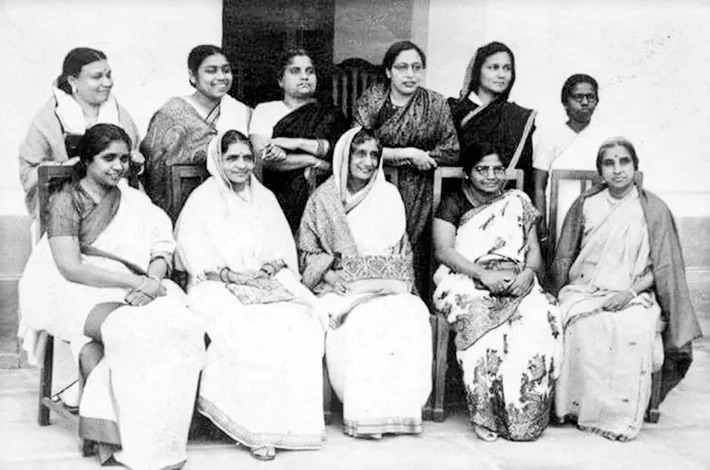
Group photograph of eleven women in saris, six seated on chairs in front and five standing behind, on a veranda.
PhotographA group portrait of women members of India's Constituent Assembly. The copy available to this archive carries no key identifying the individuals, and none is supplied here.

The arithmetic

Fifteen out of roughly three hundred

The Constituent Assembly had about 299 members. Fifteen of them were women. There was no reservation and no quota; each had arrived through the provincial legislatures and through two decades of movement work.

Durgabai signed the register on the Assembly's opening day, 9 December 1946, for the Madras (General) constituency. The Rajya Sabha Secretariat's 2012 volume of selected speeches by the Assembly's women members prints sixteen separate interventions by her — more than for any other woman member in that collection.

Interactive record

The document table

Ten matters on which her position is recorded in the Constituent Assembly Debates. Open any row for her role, the historical context, and why it mattered. Every row carries its volume, date and page reference. Nothing here is paraphrased into her mouth: where she is quoted, the words are hers as printed.

Her role

She spoke in support of the draft article that became Article 32, and answered two technical objections: whether the Supreme Court's power to issue writs displaced that of the High Courts, and whether a refusal by a High Court barred an application to the Supreme Court. She said no to both.

Historical context

The Assembly was deciding whether the fundamental rights it had just written would be enforceable at all, and by which court. Ambedkar would later call this article the heart and soul of the Constitution.

Significance

Her formulation is among the sharpest in the debate: this is “a right which is fundamental to all the fundamental rights guaranteed under this Constitution”, because “a right without an expeditious and effective remedy… is not worth the paper on which it is written”.

Source: Constituent Assembly of India Debates, Vol. VII, 9 December 1948, pp. 937–938, as reprinted in Selected Speeches of Women Members of the Constituent Assembly, Rajya Sabha Secretariat, New Delhi, April 2012.
Her role

She moved an amendment to substitute the words “all classes and sections” for “any class or section” in the clause permitting the State to legislate for social welfare and reform and for throwing open Hindu religious institutions of a public character.

Historical context

Temple-entry legislation already existed in several provinces, but she argued that distinctions persisted in the other institutions attached to temples and maths — the pathsalas and schools. Her object, in her words, was “to enlarge the scope of the clause”.

Significance

The wording finally adopted in Article 25(2)(b) of the Constitution is “all classes and sections of Hindus” — the broader formulation she moved. It is her most direct and checkable mark on the text of the Constitution.

Source: Constituent Assembly of India Debates, Vol. VII, 6 December 1948, pp. 828–829 (on draft Article 19). Compare the enacted text of Article 25(2)(b).

Her role

On the article against exploitation she spoke to K. T. Shah's amendment, which would have written the prohibition of dedication as devadasis into the constitutional text. She accepted the object entirely but argued the amendment was unnecessary, since Madras had already prohibited the practice by statute.

Historical context

She was blunt that the province she represented was the worst affected: “if any province has suffered from this bad practice… it is the province of Madras”. She credited the reformer Muthulakshmi Reddy, by name, for the law that ended it.

Significance

It shows her characteristic instinct — she asked what already worked before adding new text — and it shows her crediting another woman reformer on the record rather than claiming the ground herself.

Source: Constituent Assembly of India Debates, Vol. VII, 3 December 1948, p. 808 (on draft Article 17).

Her role

She supported an amendment to add abandoned and exploited children to the Concurrent List, arguing that recognising the principle only among the Directive Principles left it “a pious declaration”, and that without a legislative entry nobody would know whether the Centre or a State was responsible.

Historical context

Care for destitute children was then overwhelmingly the work of private philanthropy, chronically underfunded. She had seen this at close range: “We know how these associations are struggling for their daily existence…”

Significance

This is the clearest early statement of the position that would define her second career: “This is not a matter which could be left to private enterprise, but the State must take direct responsibility.” Four years later she chaired the board that put public money behind voluntary welfare work.

Source: Constituent Assembly of India Debates, Vol. IX, 3 September 1949, pp. 933–937 (on Entry 6 of the Concurrent List).

Her role

She argued that the national language “should not be and cannot be any other than Hindustani which is Hindi plus Urdu”, accepted Hindi in the Devanagari script as a concession, and set two conditions: that the language be capable of absorbing words already in use from Urdu and the regional languages, and that the status quo be maintained for fifteen years.

Historical context

She spoke as a southerner who had spent her adolescence propagating Hindi in the South at Gandhi's request, against strong local opposition — which gave her standing to warn about how the campaign was now being conducted. She called the insistence on Hindi numerals “the height… of language tyranny and intolerance”.

Significance

The Constitution as adopted gave English a fifteen-year term alongside Hindi for official purposes. Her speech is a first-hand account of why non-Hindi members regarded that period as a condition rather than a courtesy.

Source: Constituent Assembly of India Debates, Vol. IX, 14 September 1949, pp. 1426–1429.

Her role

In the Assembly's earliest work on the judiciary she spoke on the appointment of judges of provincial High Courts, on establishing High Courts in newly created provinces, and on the requirement that judges be citizens of India.

Historical context

These were the practical foundations of an independent judiciary: who chooses judges, what protects them from the executive, and what happens to justice in provinces about to be created or redrawn.

Significance

Judicial independence is the subject she returned to most often. It is the natural preoccupation of a working advocate, and it is why she is described in accounts of the Assembly as a consistent defender of a free judiciary.

Sources: Constituent Assembly of India Debates, Vol. IV, 21 July 1947, pp. 695–697; 28 July 1947, p. 887; 29 July 1947, pp. 905–908.

Her role

She spoke on the terms of the Supreme Court's appellate jurisdiction in civil matters as the Assembly settled the shape of the new court.

Historical context

The Federal Court was becoming the Supreme Court of a republic, and appeals to the Judicial Committee of the Privy Council in London were to end. What replaced them had to be defined precisely.

Significance

In her closing speech on the Constitution she returned to this design and singled it out: unlike the American model, India would have a single hierarchy of courts administering both central and state law, headed by one Supreme Court.

Source: Constituent Assembly of India Debates, Vol. VIII, 6 June 1949, pp. 626–627.

Her role

She moved an amendment to lower the minimum age for a seat in the Council of States from thirty-five to thirty, on the ground that “wisdom does not depend on age” and that young people should be trained early in the affairs of state.

Historical context

The Upper House was conceived as a revising chamber of elders. She argued that the assumption behind the age bar belonged to an order that had already been replaced.

Significance

The amendment did not carry; the Constitution retained thirty for the Council of States under Article 84. The episode is a useful corrective to accounts that imply everything she proposed was adopted — much of it was not.

Source: Constituent Assembly of India Debates, Vol. VIII, 18 May 1949, p. 90 (on new Article 68A).

Her role

She supported appointment over direct election, telling the House frankly that she had once held the opposite view and had changed her mind. Her reason was that a Governor dependent on votes could not be “above party politics”.

Historical context

The Assembly was deciding whether the head of a State should have an independent electoral mandate — and therefore a rival claim to legitimacy against the elected State government.

Significance

The Constitution provides for appointment by the President. Her intervention is also a small piece of evidence about her temperament: she recorded a change of mind in public, which is rarer in the debates than one might expect.

Source: Constituent Assembly of India Debates, Vol. VIII, 31 May 1949, pp. 448–450 (on draft Article 131).

Her role

She spoke in support of Ambedkar's motion to pass the Constitution, defending it against critics on the left who wanted a particular ideology written in, and against those who called the fundamental rights worthless because they carried restrictions.

Historical context

This was the closing debate. Members were summing up three years of work in the knowledge that the document would be adopted two days later, on 26 November 1949.

Significance

Her test for the Constitution was functional rather than ideological: does it “establish a machinery to find out the general will of the people and also to give scope for the general will to prevail”? She called it “a people's Constitution”, deliberately left open for the country to make its own experiments.

Source: Constituent Assembly of India Debates, Vol. XI, 24 November 1949, pp. 886–889.

From her closing speech

“…make, in the first instance, membership of this House the membership of Parliament, not a position of unusual prestige or of position and power, but a post of duty and of heavy responsibility, a post of duty and very hard and efficient work.”
G. Durgabai, Constituent Assembly of India Debates, Vol. XI, 24 November 1949

She said this two days before the Constitution was adopted, while arguing that the risks people feared in universal adult franchise would be answered less by constitutional safeguards than by changing what a seat in Parliament was understood to be.

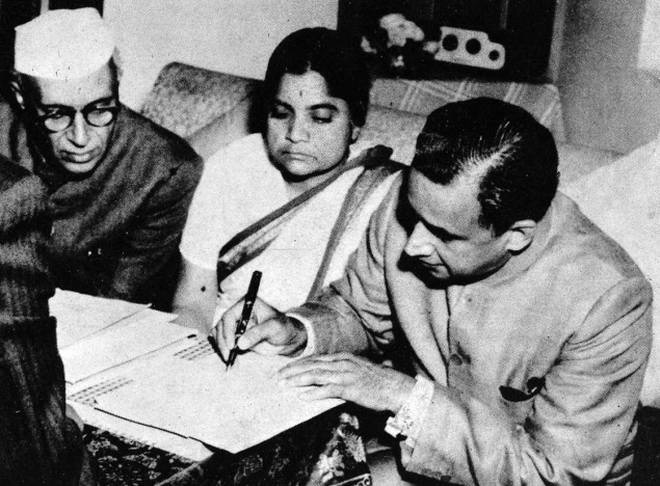
Durgabai Deshmukh seated between two men at a low table; the man on the right signs a document with a fountain pen while she watches.
PhotographDurgabai Deshmukh at the signing of a document. The other individuals, the occasion and the date are not identified in the copy available to this archive, and are not guessed at here.

Committees, and the work nobody photographs

Beyond the floor of the House she sat on the Assembly's machinery. She was a member of the Committee on the Rules of Procedure — the body that decided how the Assembly would conduct itself — and by most accounts the only woman on it. She is also described as having served on the Steering Committee and among the Assembly's panel of chairmen; the panel claim appears widely but rests on secondary accounts.

Rules committees are where the tedious, decisive work happens: who may speak, for how long, in what order, and what a member may move. It is exactly the kind of assignment that suited her, and exactly the kind that leaves no monument.

The Provisional Parliament, and a defeat

When the Constitution came into force on 26 January 1950, the Constituent Assembly continued as the Provisional Parliament of India until the first general election. Durgabai served in it, and took part in debates including those on women's property rights under the Hindu Code Bill.

At the general election of 1952 she stood, and lost. This is not a footnote to be hurried past. The woman who had helped write the Constitution and had spoken more often in the Assembly than any other woman member was not returned by an electorate.

What happened next says something about the period. She was appointed to the Planning Commission — its first woman member — and given charge of social services. The most consequential decade of her public life followed a rejection at the polls.

The Planning Commission, 1952

The Planning Commission had been set up in 1950 to draw up India's five-year plans. When Durgabai joined it in 1952 the First Five Year Plan was in progress, and social services were the part of it least well defended against the claims of irrigation, steel and power.

Her argument there was the one she had made to the Constituent Assembly in 1949: welfare cannot be left to private philanthropy, because philanthropy is chronically underfunded and answerable to nobody. She pressed for the Government to declare a national policy on social work and to fund it. The result, in 1953, was the Central Social Welfare Board, with Durgabai as its founder chairperson.

That is the hinge of her whole life: a movement organiser became a constitutional actor, and a constitutional actor became an administrator of the machinery she had argued for. Chapter 06 follows what the machinery did.

Principal sources for this chapter

  • Selected Speeches of Women Members of the Constituent Assembly, Rajya Sabha Secretariat, New Delhi, April 2012 — which reprints sixteen of her interventions with their original volume, date and page citations.
  • Constituent Assembly of India Debates, Volumes IV, VII, VIII, IX and XI.
  • The enacted text of the Constitution of India, for Articles 25(2)(b), 32, 84 and 155.
  • The Constituent Assembly member profile maintained by the Constitution of India archive project, for her committee membership.